November 17, 2026
Your Muscles Have a Brake. It’s Written in Your DNA.
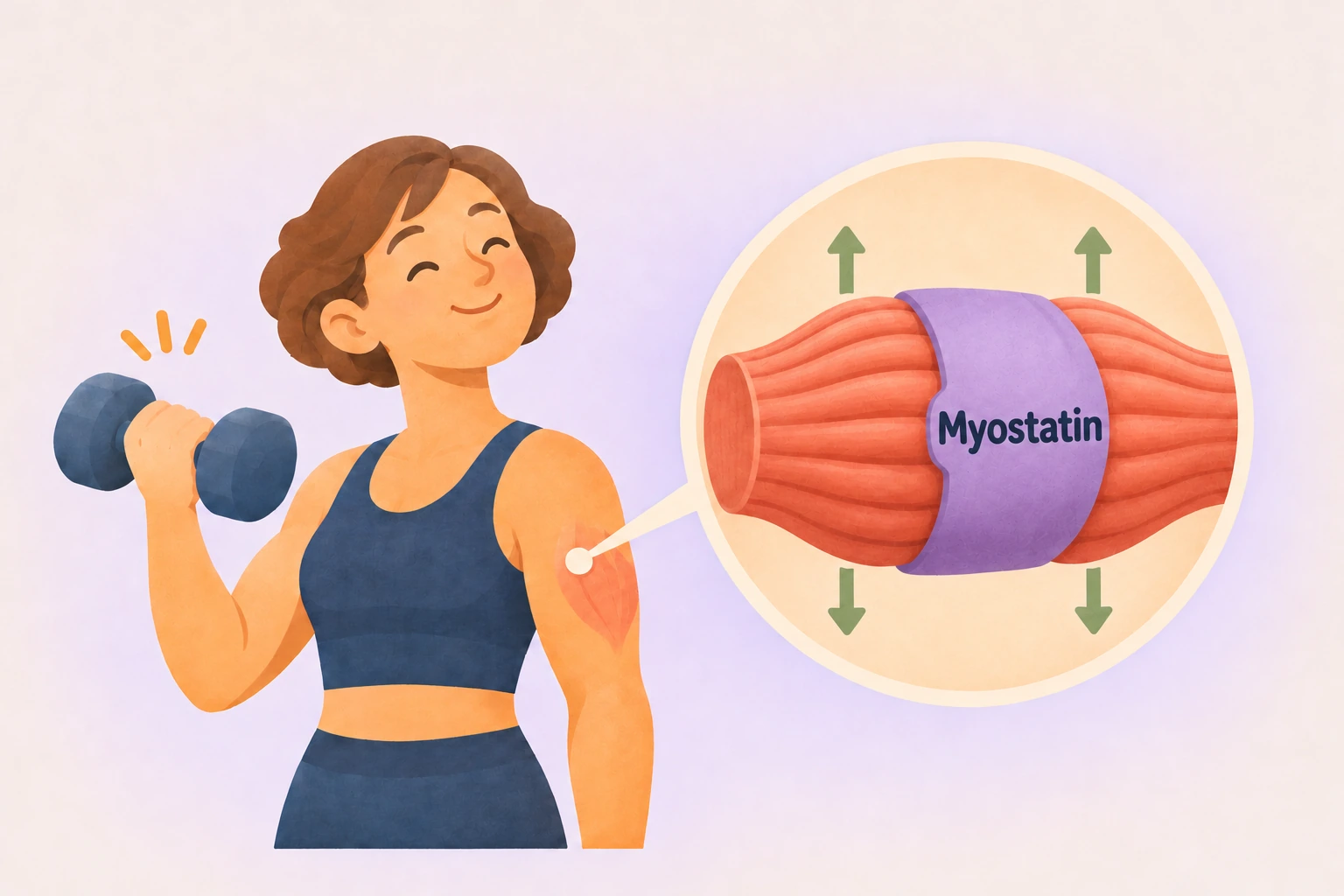
Everyone knows you lift weights to build muscle. But did you know your body makes a protein to slow muscle growth?
That protein is called myostatin and it helps keep muscle growth in check. Certain inherited changes in the gene that produces it can weaken that restraint and lead to outsized muscle growth. Must be nice!
Meet your muscle’s built-in brake
The MSTN gene carries the instructions for myostatin. Once active, the protein sends signals that limit muscle growth. Think of it as part of the system that decides how much muscle your body builds and maintains.
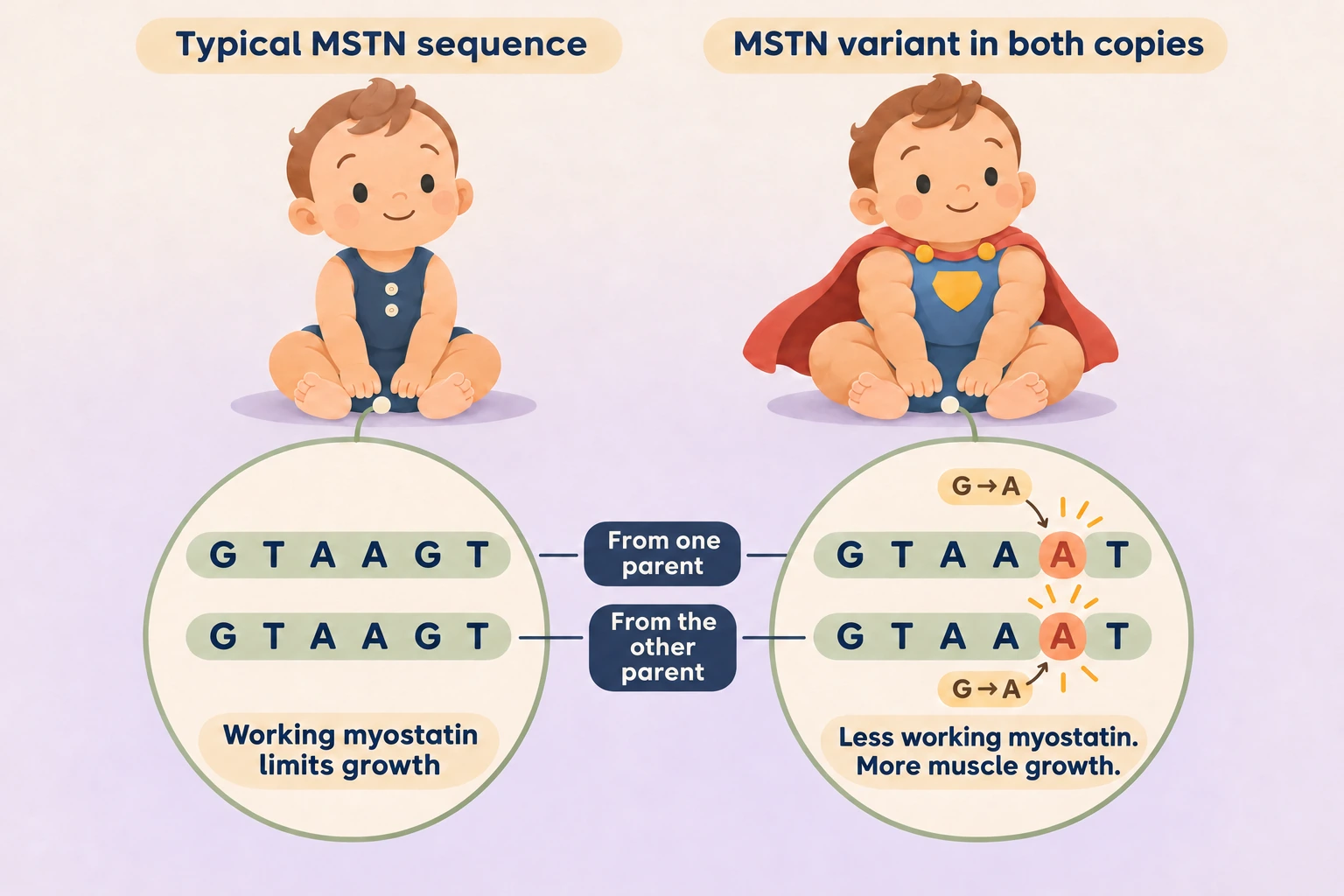
That system starts working before birth and stays active throughout life. Training encourages your muscles to grow; myostatin helps regulate how far growth goes. Some DNA variants change those instructions, leaving the body with less working myostatin, and more unrestrained muscle growth.
One DNA letter can change the message
In 2004, the New England Journal of Medicine published a landmark report documenting researchers’ discovery of the first known human case of a loss-of-function mutation in the myostatin gene—a change that prevented the body from making working myostatin. The human of interest? A four-year-old child. Researchers found a rare change in both copies of his MSTN gene: a DNA letter normally written as G had become A.
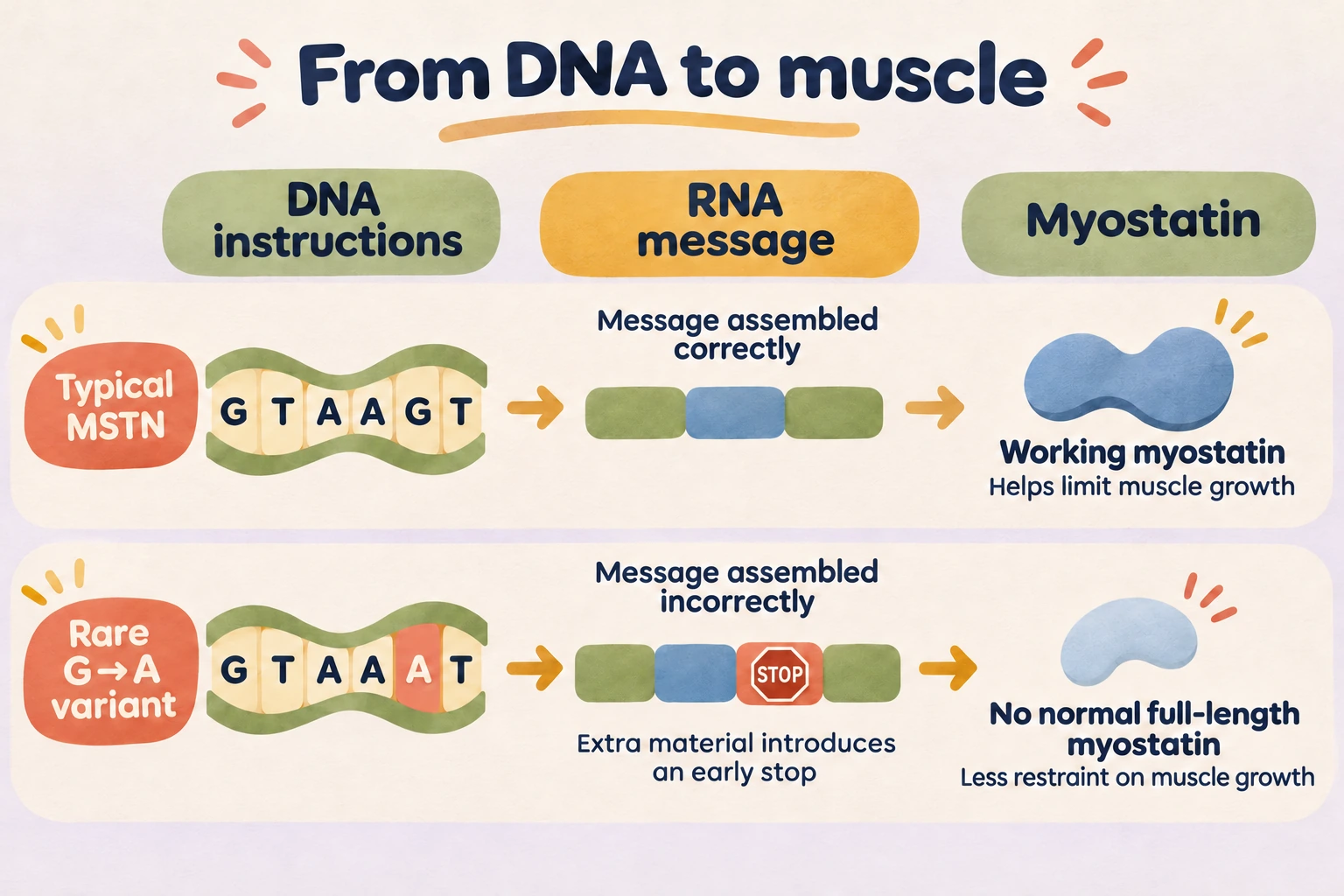
Here's how it happened. Before a cell makes a protein, it copies the gene’s instructions into an RNA message and removes sections it doesn’t need. This change disrupted that editing step. Extra material stayed in the message, introducing an early stop signal and preventing production of normal, full-length myostatin.
The result was a striking example of what happens when the brake is weakened: at birth, the child “appeared extraordinarily muscular, with protruding muscles in his thighs.” By four and a half, he could hold a nearly 7-lb dumbbell in each hand with his arms extended horizontally. Arnold Schwarzenegger who?
So why does your gym partner gain muscle faster?
That child’s case shows how much one gene can matter. But most people don’t carry a rare MSTN change with such a dramatic effect. Understanding everyday differences in muscle means looking at many genes together.
A study of roughly 450,000 people identified many genetic associations with lean mass in the arms and legs. Myostatin is one part of that biology; muscle development involves many genes and the signals that control their activity.
There’s also a difference between how much muscle you have and how much you gain from training. People following a standardized resistance-training program can make very different gains, but those differences don’t all come from DNA. Previous training, food, recovery and the exercise itself also shape the outcome.
Myostatin makes one thing especially clear: muscle growth depends on the biological signals responding to your effort, in addition to the effort itself.
Where Lifecode comes in
A list of genetic variants tells you what differs in your DNA. The next question is more interesting: what might those differences change?
Lifecode uses whole-genome sequencing to examine DNA across protein-coding regions and the surrounding sequences involved in controlling how genes are expressed. The MSTN example shows why that broader view matters: a change outside the protein-coding instructions can still affect the protein a cell produces.
For complex traits, our team of computational biologists and computer scientists studies predicted effects on gene activity, then connects those predictions with traits measured in people. This helps Lifecode connect differences in your DNA to what you actually care about: how your body looks, feels and functions.
For muscles, that means looking beyond a single “strength gene” toward the many signals involved in building and maintaining muscle.
The same reading, everywhere else
The importance of gene activity shows up elsewhere in your routine, too. Near LCT, inherited DNA differences help determine whether your gut keeps making the enzyme that digests milk sugar. Around MSTN, differences can alter how a muscle-growth regulator is produced or functions. Different traits, connected by how your cells use their instructions.
For traits shaped by many genes, models such as AlphaGenome and Borzoi help predict how DNA differences affect gene activity. Lifecode’s proprietary scoring algorithms connect those predictions with traits measured in people to estimate inherited tendencies in skin, hair, fitness, and other health and wellness traits.
Lifecode reads all 3 billion letters of it once, then re-reads them as the science improves, so what your sequence says about this today is the least it will ever tell you. That is why we built Lifecode.
Read your own genome.
Order your genome