
You drank milk growing up without a thought. Now a latte leaves you bloated. Why is that?
For many people, that change has a genetic explanation. Your genes help determine whether your gut keeps making lactase as you get older. Lactose intolerance can develop when lactase production drops, leaving you with less of the enzyme that digests milk sugar.
Why milk starts causing trouble
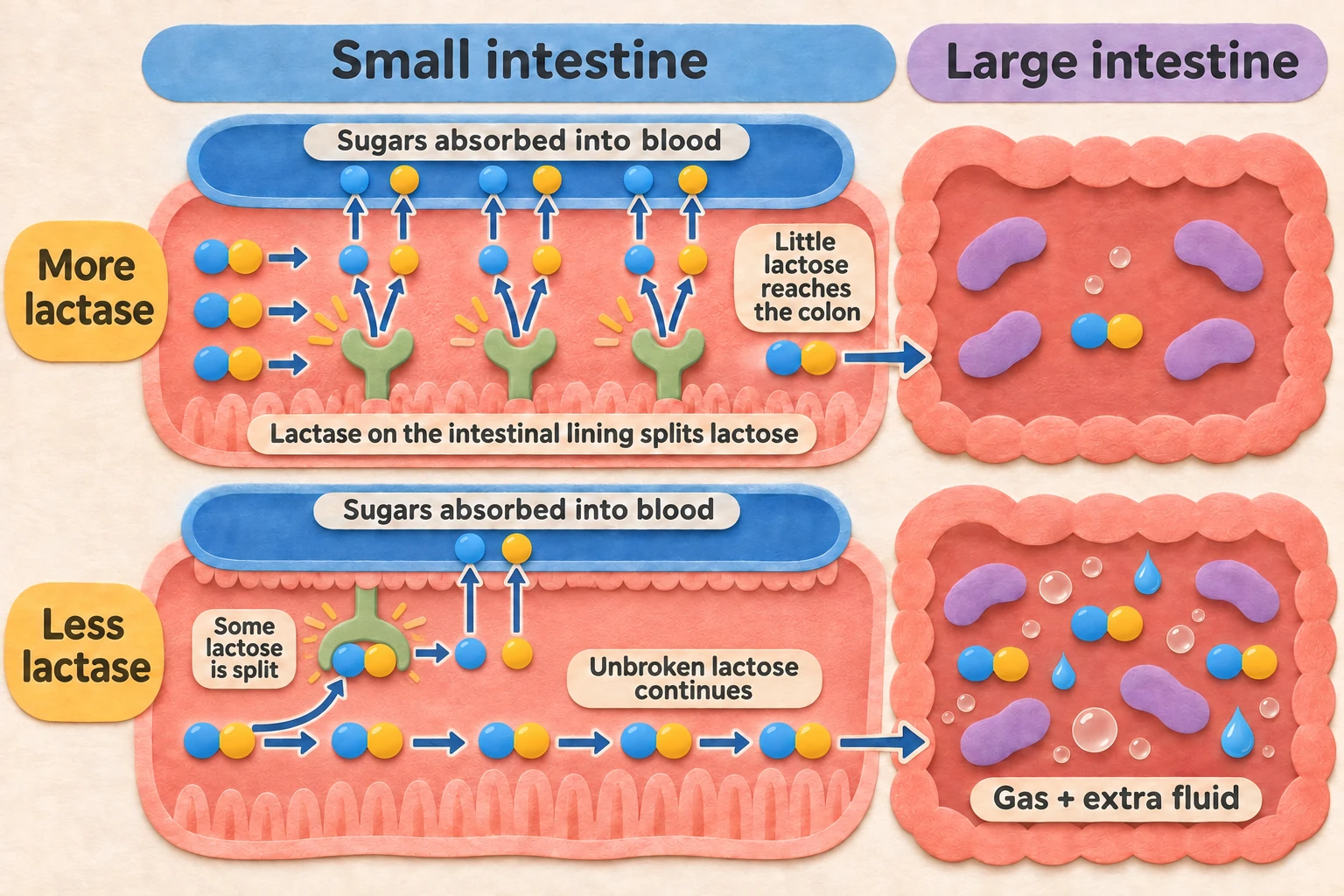
Milk contains lactose, a sugar that needs to be broken down before your small intestine can absorb it. An enzyme called lactase breaks it into smaller sugars.
With enough lactase, those smaller sugars cross the intestinal wall. With less, more lactose stays unbroken and reaches the large intestine. It draws water into the bowel, and bacteria ferment it, producing gas. That combination can cause bloating, pain and diarrhea. Sound familiar?
Is lactose intolerance genetic?
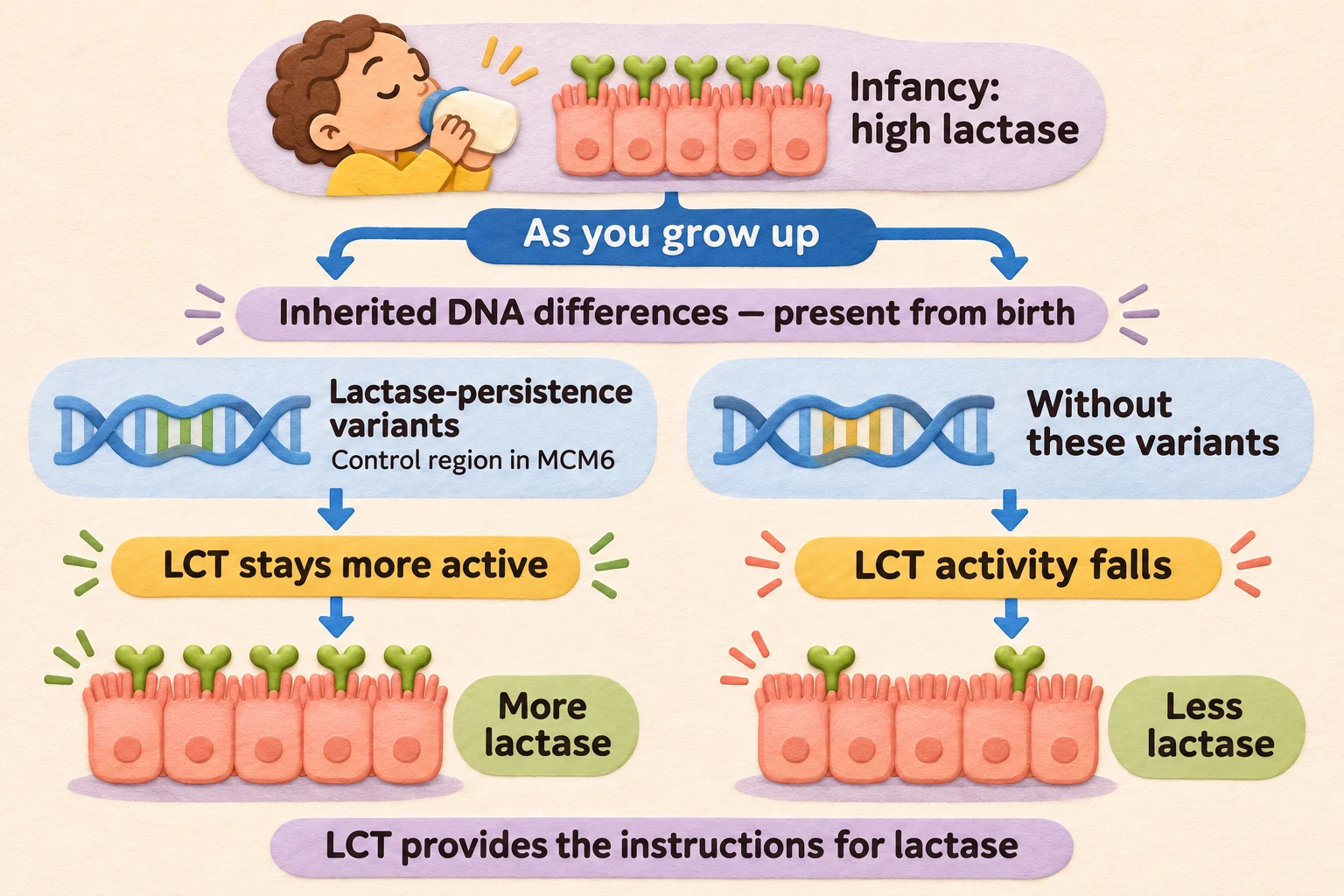
Often, yes. LCT carries the instructions for lactase. A control region inside a nearby gene, MCM6, helps determine whether LCT stays active as you grow up. Some inherited variants keep lactase production higher into adulthood, a pattern called lactase persistence.
Without a lactase-persistence variant, production commonly falls after infancy. Symptoms can appear later, when a serving contains more lactose than your gut can break down.
To be clear, your gut may still make enough lactase for a small amount of dairy. A large latte contains much more lactose than your coffee with a splash of milk, which might offer a glimmer of hope for the caffeine aficionados among us. Also, hard cheeses such as cheddar contain very little lactose, so your afternoon string cheese may still be on the menu. What ultimately will control how you feel is the amount of lactose in what you consume - that explains why some dairy can sit comfortably while others lead to queasy outcomes.
Lifecode can help examine LCT and its nearby DNA controls for inherited differences linked to lactase production in adulthood.
Keep the dairy that works for you
So what does this mean for you? Below are a few easy lifestyle upgrades that can prevent any unwanted gassiness (or worse, bowel movements).
Your usual milk. Try a lactose-free version in the same drink. The lactose is already broken down, while the milk still provides its usual nutrients.
Your portions. Try smaller amounts with meals. Yogurt and hard cheeses are often easier to tolerate. Keep calcium and vitamin D in your diet if you reduce dairy.
Your symptoms. Discuss sudden or persistent changes with your doctor, especially if reducing lactose doesn’t help. Infections or damage to the small intestine can also reduce lactase.
The same reading, everywhere else
The control region near LCT has a parallel in IRF4, where altered gene activity affects skin pigmentation. They sit in your genome alongside the genes that set how you respond to caffeine, how your skin ages and how your body handles alcohol. You read all of it once.
For traits shaped by many genes, models such as AlphaGenome and Borzoi help predict how DNA differences affect gene activity. Our proprietary scoring algorithms connect those predictions with traits measured in people to estimate inherited tendencies in skin, hair, fitness, and other health and wellness traits.
Lifecode reads all 3 billion letters of it once, then re-reads them as the science improves, so what your sequence says about this today is the least it will ever tell you. That is why we built Lifecode.
Read your own genome.
Order your genome